
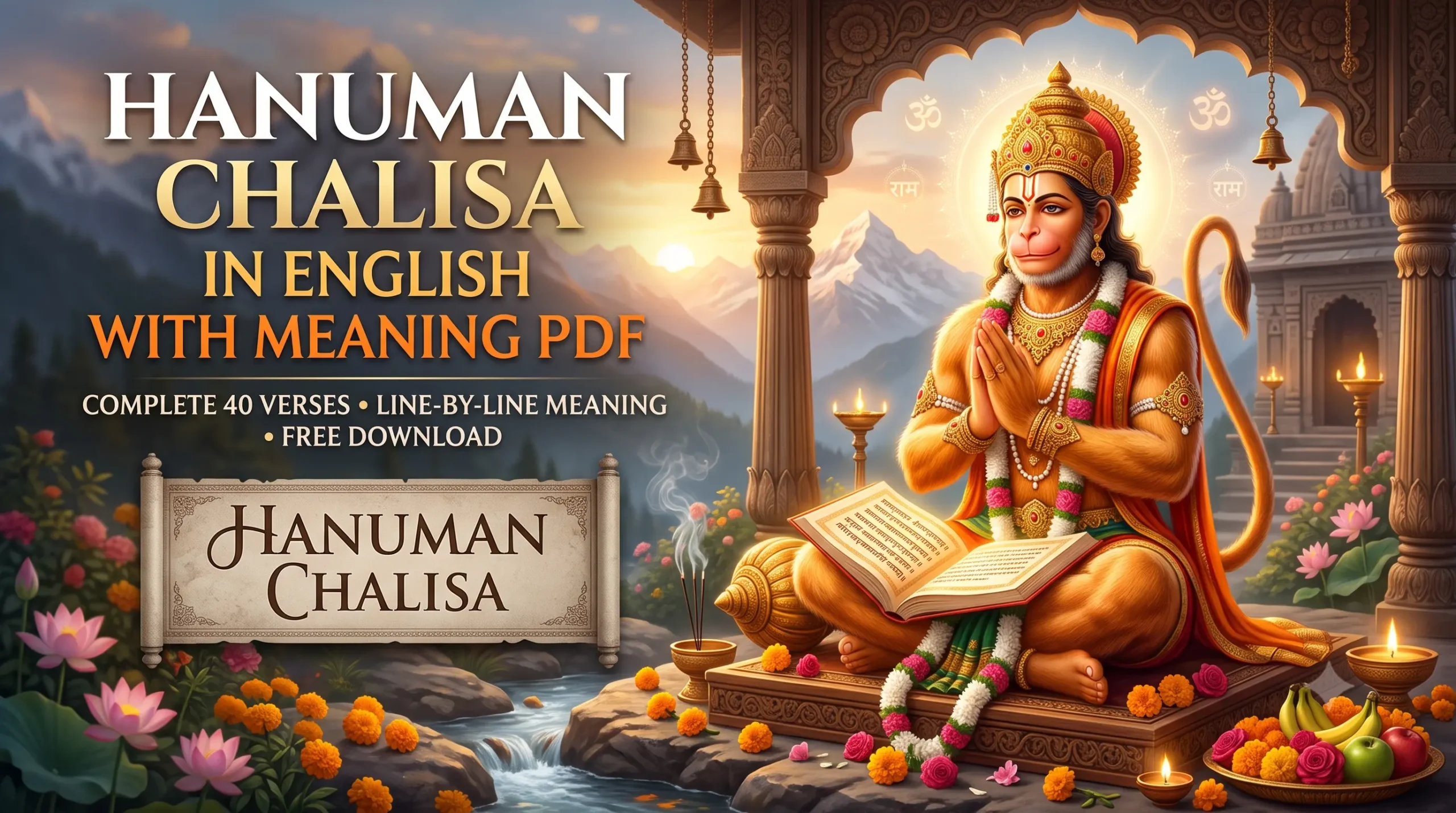
Composed by poet-saint Tulsidas in the 16th century, the sacred 40-verse Hanuman Chalisa brings inner peace, removes fear, and builds mental resilience.
This guide features the complete hymn in English with line-by-line meanings, along with a free downloadable PDF for your daily sadhana.
📥 Download Free Hanuman Chalisa in English PDF
Keep the full verses and their English translation handy for your daily prayers:
(High-Quality, Mobile-Friendly PDF Print)
Opening Dohas (Introductory Verses)
Doha 1
Shri Guru Charan Saroj Raj, Nij Manu Mukuru Sudhari |
Barnau Raghubar Bimal Jasu, Jo Dayaku Phala Chari ||
Meaning: Cleansing the mirror of my mind with the dust from the lotus feet of my Divine Guru, I sing the pure glory of Lord Ram, which bestows the four fruits of life (Dharma, Artha, Kama, and Moksha).
Doha 2
Buddhi Heen Thanu Janike, Sumirau Pawan-Kumar |
Bal Buddhi Vidya Dehu Mohi, Harahu Klesh Bikaar ||
Meaning: Knowing myself to be lacking in wisdom, I meditate upon you, O Son of the Wind! Grant me strength, wisdom, and knowledge, and remove my afflictions and flaws.
The 40 Chaupais (Complete Verses)
Verse 1
Jai Hanuman Gyan Gun Sagar | Jai Kapis Tihun Lok Ujagar || 1 ||
Meaning: Victory to Lord Hanuman, the ocean of wisdom and virtue! Victory to the supreme Lord of monkeys, who illuminates all three worlds!
Verse 2
Ram Doot Atulit Bal Dhama | Anjani Putra Pawan Sut Nama || 2 ||
Meaning: You are the messenger of Lord Ram, the reservoir of incomparable power. You are known as the son of Anjani and the son of the Wind God (Pawan-Sut).
Verse 3
Mahabir Bikram Bajrangi | Kumati Nivar Sumati Ke Sangi || 3 ||
Meaning: Great hero, possessing immense strength, your body is as strong as a thunderbolt (Vajra). You remove foolish thoughts and grant wisdom to those with pure intent.
Verse 4
Kankan Baran Bira Suvesha | Kanan Kundal Kunchit Kesha || 4 ||
Meaning: Your complexion is radiant like gold, and you wear fine garments. You are adorned with beautiful earrings and lovely curly hair.
Verse 5
Hath Vajra Aur Dhwaja Biraje | Kaandhe Munj Janeu Saaje || 5 ||
Meaning: In your hands, you hold the thunderbolt and a victory flag, while a sacred thread (Janeu) made of Munja grass adorns your shoulder.
Verse 6
Sankar Suvan Kesari Nandan | Tej Pratap Maha Jag Vandan || 6 ||
Meaning: You are an incarnation of Lord Shiva and the joy of King Kesari. Your celestial radiance and glory are revered across the entire universe.
Verse 7
Vidyavan Guni Ati Chatur | Ram Kaj Karibe Ko Aatur || 7 ||
Meaning: You are supremely learned, virtuous, and clever. You are always eager to serve Lord Ram and execute His divine tasks.
Verse 8
Prabhu Charitra Sunibe Ko Rasiya | Ram Lakhan Sita Man Basiya || 8 ||
Meaning: You delight in listening to the divine stories of Lord Ram. Lord Ram, Lakshman, and Goddess Sita reside permanently in your heart.
Verse 9
Sukshma Roop Dhari Siyahi Dikhava | Bikat Roop Dhari Lanka Jarava || 9 ||
Meaning: You assumed a microscopic form to appear before Sita Ji in Lanka, and a massive, terrifying form to burn the kingdom of Lanka down.
Verse 10
Bhim Roop Dhari Asur Samhare | Ramchandra Ke Kaj Sanvare || 10 ||
Meaning: Taking on a gigantic warrior form, you destroyed the demons and successfully fulfilled the mission of Lord Ram.
Verse 11
Laye Sanjivan Lakhan Jiyaye | Shri Raghuvir Harashi Ur Laye || 11 ||
Meaning: You brought the Sanjeevani herb to revive Lakshman, causing Lord Ram to embrace you in immense joy and gratitude.
Verse 12
Raghupati Kinhi Bahut Badai | Tum Mam Priya Bharat Hi Sam Bhai || 12 ||
Meaning: Lord Ram praised you profusely and declared, “You are as dear to me as my own brother Bharat.”
Verse 13
Sahas Badan Tumharo Jas Gave | Asa Kahi Shripati Kanth Lagave || 13 ||
Meaning: Saying that even the thousand-headed cosmic serpent Sheshnag sings your glory, Lord Ram lovingly embraced you again.
Verse 14
Sankadik Brahmadi Munisa | Narad Sharad Sahit Ahisa || 14 ||
Meaning: Sages like Sanaka, gods like Brahma, great hermits, Narada, Goddess Saraswati, and Sheshnag cannot fully express your vast glory.
Verse 15
Jam Kuber Digpal Jahan Te | Kavi Kovid Kahi Sake Kahan Te || 15 ||
Meaning: Yamraj (God of Death), Kuber (God of Wealth), the guardians of the directions, poets, and scholars all fail to fully describe your greatness.
Verse 16
Tum Karoppkar Sugrivahi Keenha | Ram Milaye Rajpad Deenha || 16 ||
Meaning: You rendered a great service to Sugriva by introducing him to Lord Ram, thereby restoring his kingdom to him.
Verse 17
Tumharo Mantra Vibhishan Mana | Lankeshwar Bhaye Sab Jag Jaana || 17 ||
Meaning: Vibhishana followed your valuable counsel, and the whole world knows that he subsequently became the King of Lanka.
Verse 18
Yug Sahastra Yojan Par Bhanu | Leelyo Tahi Madhur Phal Janu || 18 ||
Meaning: You leaped toward the Sun, located thousands of miles away, swallowing it thinking it was a sweet ripe fruit.
Verse 19
Prabhu Mudrika Meli Mukh Mahee | Jaladhi Langhi Gaye Aachraj Nahee || 19 ||
Meaning: Holding Lord Ram’s signet ring in your mouth, you crossed the vast ocean effortlessly—which is no surprise for someone of your stature.
Verse 20
Durgam Kaj Jagat Ke Jete | Sugam Anugraha Tumhre Tete || 20 ||
Meaning: Whatever difficult tasks exist in this world become easy and achievable by your grace.
Verse 21
Ram Duware Tum Darwane | Hot Na Aagya Binu Paisaare || 21 ||
Meaning: You are the guardian at the doorway of Lord Ram’s court. No one can enter or gain His grace without your permission.
Verse 22
Sab Sukh Lahei Tumhari Sarna | Tum Rakshak Kahu Ko Darna || 22 ||
Meaning: Those who take refuge in you enjoy all happiness and peace. When you are our protector, there is nothing left to fear.
Verse 23
Aapan Tej Samharo Aapai | Teenon Lok Hank Te Kanpai || 23 ||
Meaning: You alone can control your overwhelming radiance and power. All three worlds tremble when you roar.
Verse 24
Bhoot Pisach Nikat Nahi Aave | Mahavir Jab Naam Sunave || 24 ||
Meaning: Evil spirits, ghosts, and negative energies cannot come near when your sacred name, Mahavir, is recited.
Verse 25
Nase Rog Hare Sab Peera | Japat Nirantar Hanumat Beera || 25 ||
Meaning: All diseases are destroyed and all suffering vanishes when one continuously chants the name of the brave Lord Hanuman.
Verse 26
Sankat Te Hanuman Chhudave | Man Kram Bachan Dhyan Jo Lave || 26 ||
Meaning: Lord Hanuman releases those from trouble who keep their mind, actions, and words focused upon Him.
Verse 27
Sab Par Ram Tapasvi Raja | Tinke Kaj Sakal Tum Saja || 27 ||
Meaning: Lord Ram is the supreme ascetic King, and you flawlessly executed all of His missions and duties.
Verse 28
Aur Manorath Jo Koi Lave | Soi Amit Jivan Phal Pave || 28 ||
Meaning: Whoever comes to you with any sincere desire fulfills it and attains the unlimited fruit of human life.
Verse 29
Charon Yug Partap Tumhara | Hai Parsiddha Jagat Ujiyara || 29 ||
Meaning: Your fame spans across all four cosmic ages (Satya, Treta, Dvapara, and Kali Yuga), and your glory illuminates the entire world.
Verse 30
Sadhu Sant Ke Tum Rakhware | Asur Nikandan Ram Dulare || 30 ||
Meaning: You are the protector of saints and sages, the destroyer of demons, and the beloved devotee of Lord Ram.
Verse 31
Ashta Siddhi Nav Nidhi Ke Data | As Bar Deen Janki Mata || 31 ||
Meaning: Mother Sita blessed you with the divine power to grant the eight supernatural accomplishments (Siddhis) and nine types of wealth (Nidhis).
Verse 32
Ram Rasayan Tumhare Pasa | Sada Raho Raghupati Ke Dasa || 32 ||
Meaning: You hold the elixir of devotion to Lord Ram (Ram Rasayan). May you eternally remain the humble servant of Lord Ram.
Verse 33
Tumhre Bhajan Ram Ko Pave | Janam Janam Ke Dukh Bisrave || 33 ||
Meaning: By singing your praises, one reaches Lord Ram and is freed from the sorrows of many lifetimes.
Verse 34
Anta Kaal Raghubar Pur Jai | Jahan Janmi Hari-Bhakta Kahai || 34 ||
Meaning: At the time of death, your devotee enters the divine abode of Lord Ram, and if reborn, is known as a true devotee of God.
Verse 35
Aur Devta Chitt Na Dharai | Hanumat Sei Sarva Sukh Karai || 35 ||
Meaning: One need not contemplate any other deity, for serving Lord Hanuman alone grants all happiness and fulfillment.
Verse 36
Sankat Kate Mite Sab Peera | Jo Sumirai Hanumat Balbeera || 36 ||
Meaning: All hardships end and all pains vanish for anyone who remembers the mighty and heroic Lord Hanuman.
Verse 37
Jai Jai Jai Hanuman Gosai | Kripa Karo Gurudev Ki Nyai || 37 ||
Meaning: Hail, Hail, Hail Lord Hanuman, master of the senses! Bestow your grace upon me as my divine spiritual master (Gurudev).
Verse 38
Jo Sat Baar Paath Kare Koi | Chhutahi Bandi Maha Sukh Hoi || 38 ||
Meaning: Whoever recites this Hanuman Chalisa a hundred times is freed from worldly bondage and attains supreme bliss.
Verse 39
Jo Yeh Padhe Hanuman Chalisa | Hoi Siddhi Sakhi Gaurisa || 39 ||
Meaning: Whoever reads the Hanuman Chalisa attains spiritual perfection, as witnessed by Lord Shiva Himself.
Verse 40
Tulsidas Sada Hari Chera | Kijai Nath Hriday Mah Dera || 40 ||
Meaning: Tulsidas is eternally the servant of the Lord. O Lord Hanuman, please reside in my heart forever.
Concluding Doha
Pawan Tanay Sankat Haran, Mangal Murati Roop |
Ram Lakhan Sita Sahit, Hridaya Basahu Sur Bhoop ||
Meaning: O Son of the Wind, dynamic deliverer from all troubles, embodiment of auspiciousness! Please reside in my heart forever along with Lord Ram, Lakshman, and Goddess Sita.
Also read – Powerful Hanuman Mantra To Remove Negative Energy.
Key Benefits of Reciting Hanuman Chalisa Daily
- Eliminates Fear and Anxiety: Chanting the verses builds confidence and removes deep-seated fear.
- Improves Focus: Regular chanting helps calm the mind before meditation, pranayama, or daily japa practice.
- Protects from Negative Energies: Verse 24 (Bhoot Pisach Nikat Nahi Aave) is widely chanted for protection from negative influences and nightmares.
- Builds Physical & Mental Strength: It instills discipline and resilience during challenging times.
Frequently Asked Questions (FAQs)
Q1: What is the best time to recite the Hanuman Chalisa?
The most auspicious times are during Brahma Muhurta (early morning before sunrise) or at sunset. However, reciting it with pure devotion at any time of the day yields immense benefits.
Q2: How many times should I read the Hanuman Chalisa daily?
Reciting it once or 7 times daily is common practice. Chanting it 108 times (Shat Chandi) during special occasions or Tuesdays/Saturdays brings exceptional mental strength and spiritual progress.
Q3: Can women recite the Hanuman Chalisa?
Yes, absolutely! Devotion knows no gender. Anyone with a pure heart and sincere intentions can recite the Hanuman Chalisa.
Q4: Should I pair Hanuman Chalisa with Japa or Meditation?
Yes! Reciting the Hanuman Chalisa before your daily Japa counter or pranayama session helps stabilize your breathing, focus your mind, and reduce stress.